
Translate quote emails
Translate both quote emails with Translations AI, driven by the languages you publish in Shopify.
If you sell across markets, your quote emails can reach buyers in their own language. You do not set up a separate translation job for each email — one Translations AI pass per language covers both quote emails together with the rest of what your customers see. Inside the editor each email still has its own tab, so you fill them in one after the other.
The setting is on the Translations tab of Advanced settings. The app describes it as: “Translate everything your customers see — quote form, storefront text and both quote emails. Languages come from Settings → Languages.”
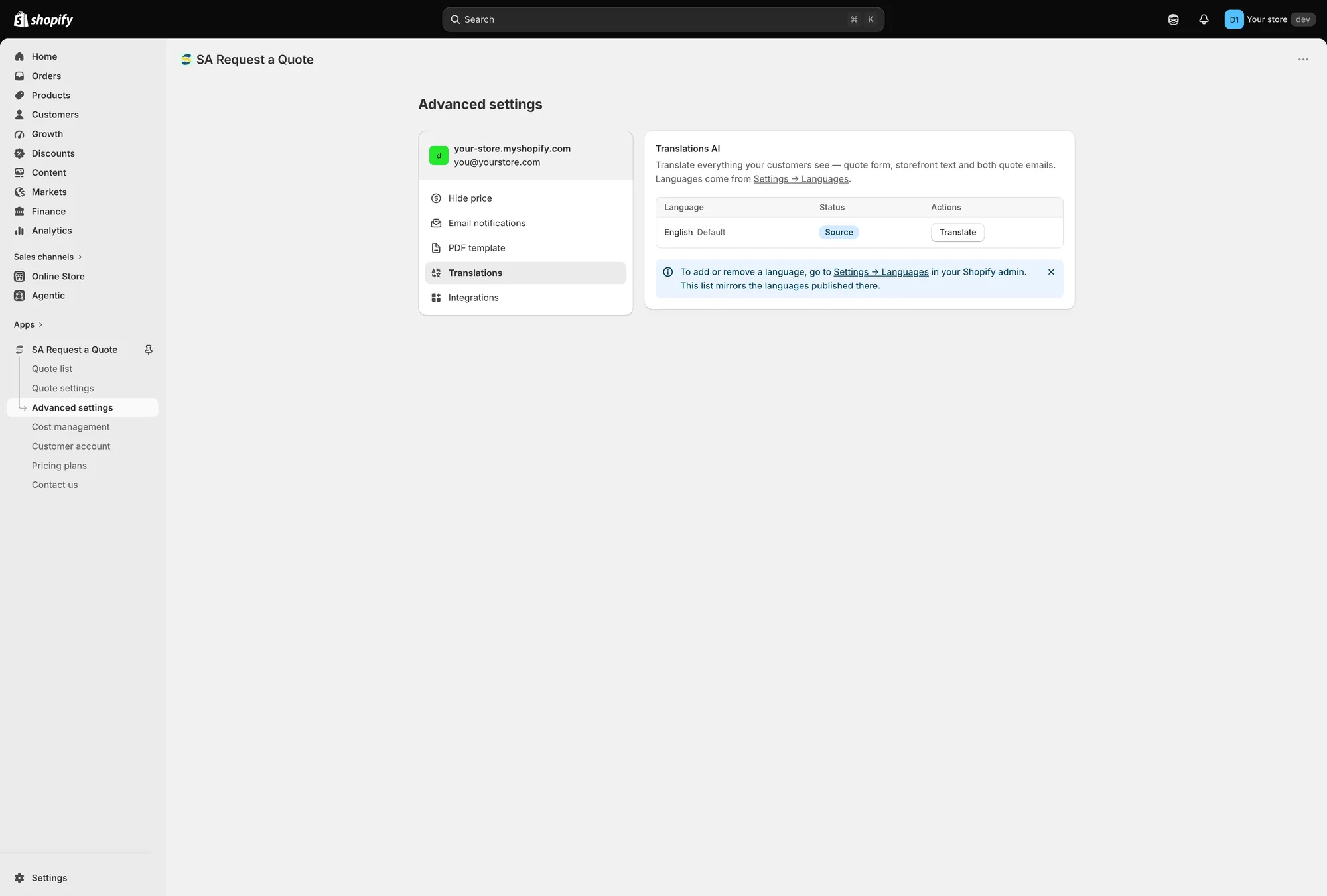
Translations AI on the Translations tab of Advanced settings.
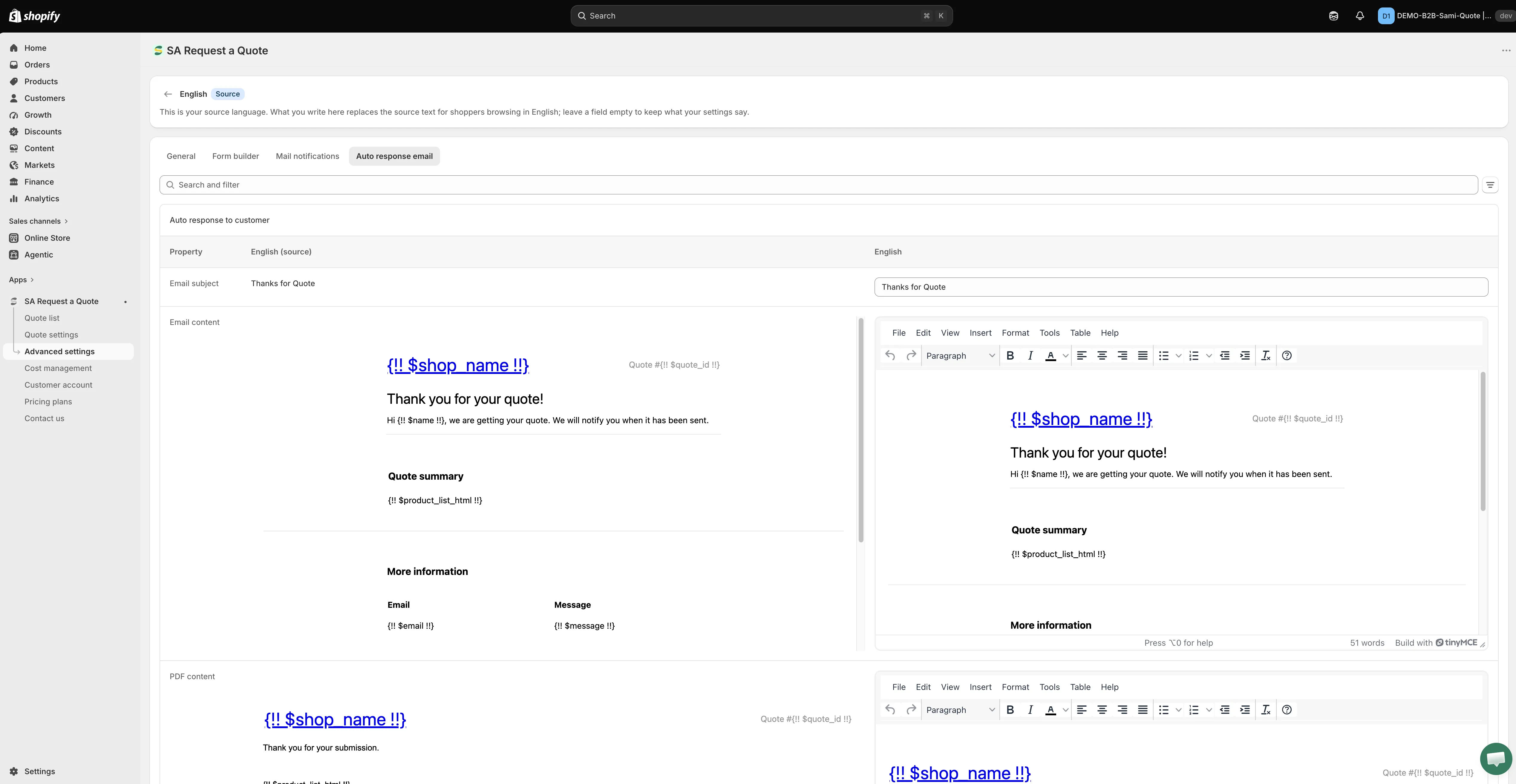
Translate both quote emails alongside the original.
Languages come from Shopify
Section titled “Languages come from Shopify”The app does not keep its own list of languages. It mirrors the ones your store publishes.
Translate your emails
Section titled “Translate your emails”-
Publish the language in Shopify
Section titled “Publish the language in Shopify”In your Shopify admin, go to Settings > Languages and publish the language you sell in. Until you do, it will not appear in the app.
-
Open the Translations tab
Section titled “Open the Translations tab”In the app, go to Advanced settings > Translations.
-
Find the language in the table
Section titled “Find the language in the table”The table lists Language, Status and Actions. Your store’s default language appears as English, marked Default, with the status Source — that is the text everything else is translated from.
-
Click Translate on that row
Section titled “Click Translate on that row”Translate sits in the Actions column. It opens a full editor for that one language, headed with the language name and, on your default language, a Source badge.
-
Switch to the email you want
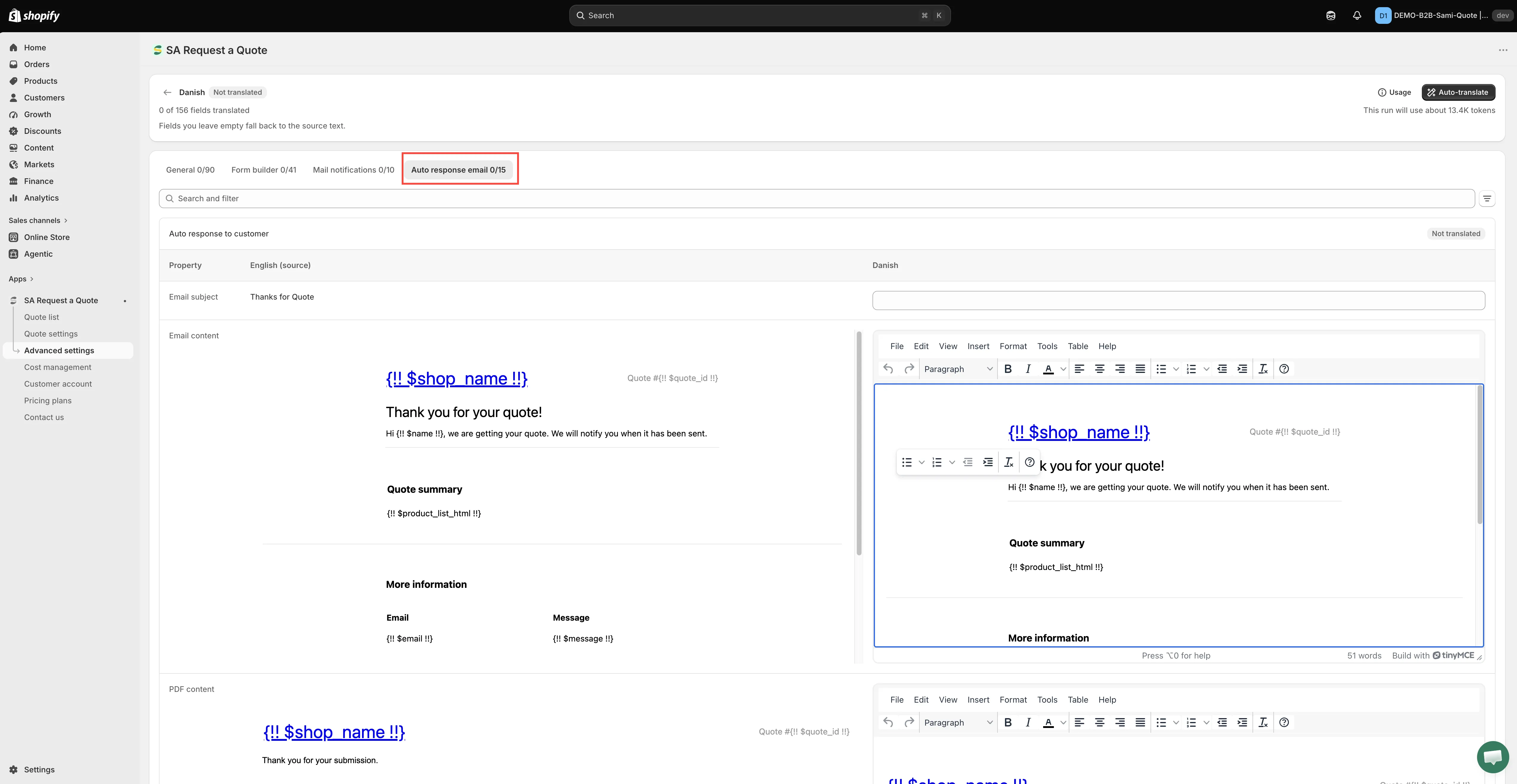
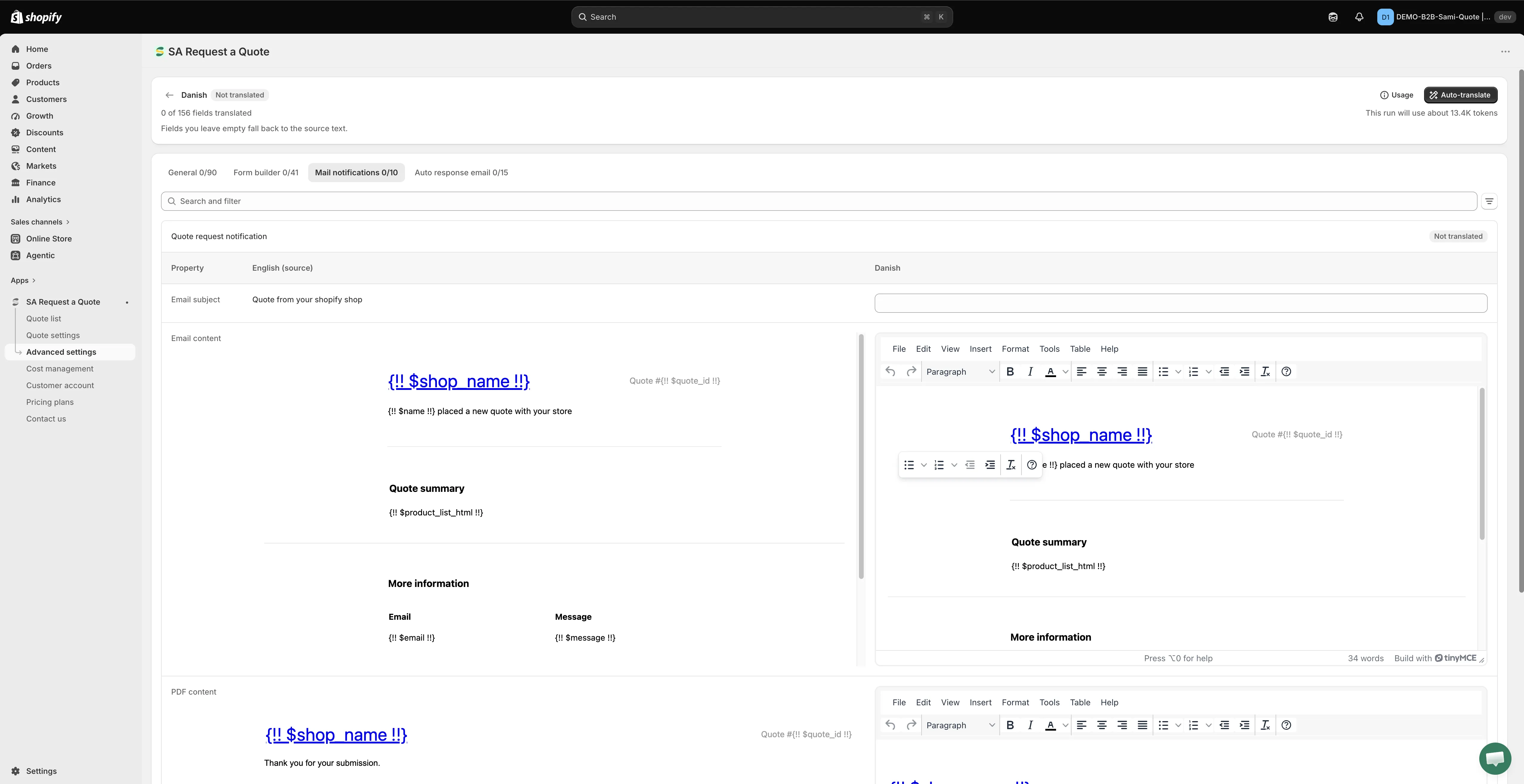
Section titled “Switch to the email you want”The editor opens on General. Your emails are not there. Across the top are four tabs — General, Form builder, Mail notifications and Auto response email — matching the four things the app says Translations AI covers: your storefront text, your quote form and the two emails.
Click the one you need:
- Mail notifications — the alert that comes to you.
- Auto response email — the confirmation that goes to your customer.
-
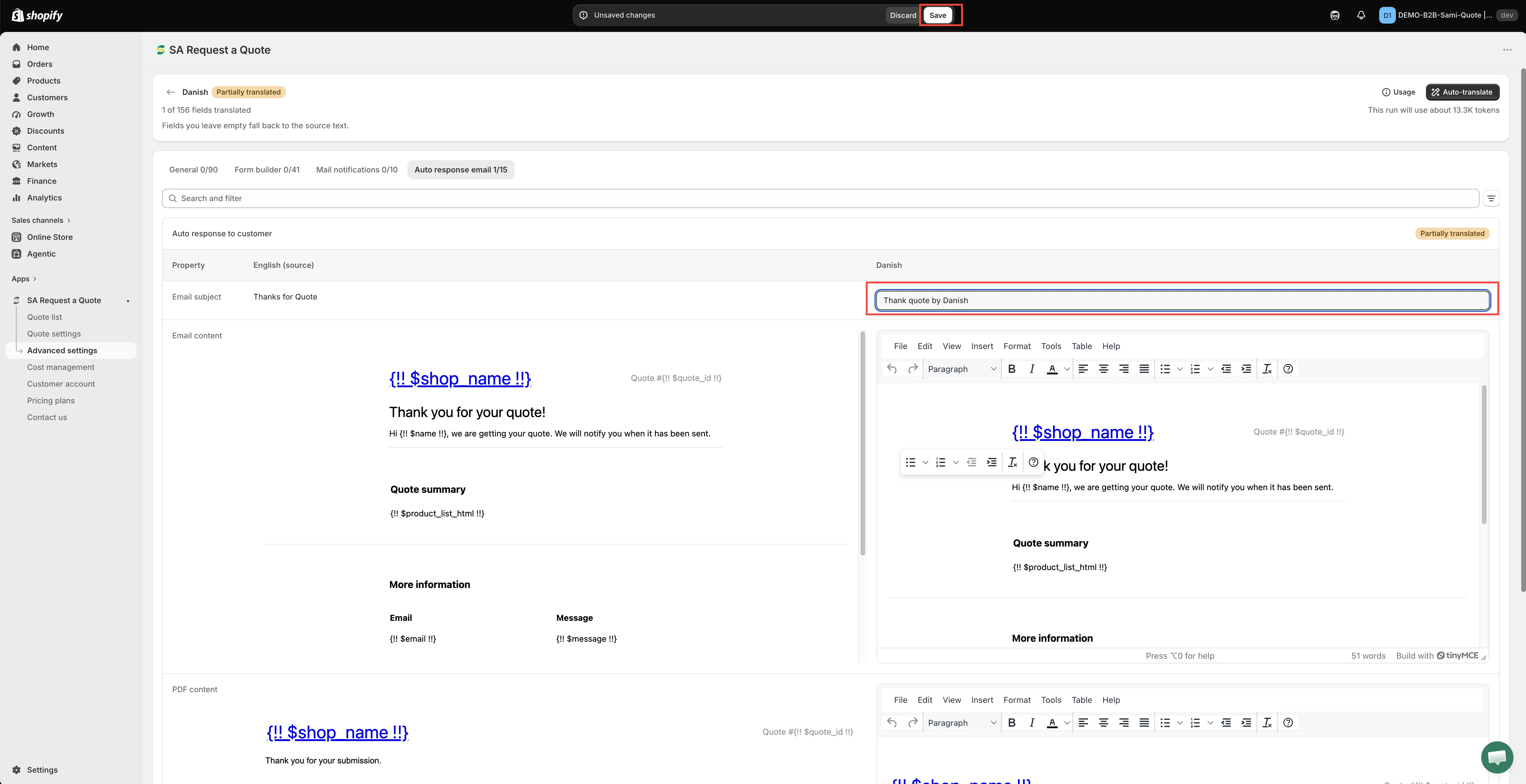
Fill in the third column
Section titled “Fill in the third column”The tab shows one section per email — Auto response to customer on the Auto response email tab — laid out as a table with three columns: Property, your source language marked (source), and the language you are translating into. You type in the third column only; the source column is there to read from.
The rows on an email tab are:
Property What you write Email subject A single-line field. This is the line a customer sees in their inbox. Email content A rich-text editor (File, Edit, View, Insert, Format, Tools, Table, Help) with the source version beside it. PDF content The same kind of editor, for the PDF wording that goes with this email. Use Search and filter above the table if you are looking for one property rather than working straight down the list.
You do not have to type every row yourself. Auto-translate fills the third column for you, and you edit what it produces rather than starting from an empty field. It is the faster way into a long email, but read the result before you save it — an automatic translation of a commercial document is a draft, not an answer.
-
Click Save to store the changes. Nothing you typed survives leaving the editor otherwise.
-
Read it back
Section titled “Read it back”Switch your storefront to that language, submit a test request, and read the email that arrives. Then repeat for every language you sell in.
An empty field is not a blank email
Section titled “An empty field is not a blank email”A field you leave empty is not published as blank — it falls back to what your settings already say. The editor states this on your source language: “This is your source language. What you write here replaces the source text for shoppers browsing in English; leave a field empty to keep what your settings say.”
So you can translate a subject line today and come back for the body tomorrow, and nothing breaks in between. The other side of that rule: if a translated email still arrives in English, check whether the field was actually filled in, rather than assuming the translation failed.
Get the source text right first
Section titled “Get the source text right first”Translations are made from your Source language, so anything you fix afterwards has to be translated again. Finish writing both emails before you translate:
- Mail notifications — the alert you receive. See Emails sent to admin.
- Auto response email — the confirmation your customer receives. See Emails sent to customers.
When it does not look right
Section titled “When it does not look right”| What you see | What to check |
|---|---|
| The language is missing from the table | It has not been published in Settings > Languages in your Shopify admin. The app mirrors that list. |
| You clicked Translate but cannot find the emails | The editor opened on General. Move to the Mail notifications or Auto response email tab. |
| Your wording is gone when you come back | The editor was left without clicking Save. |
| The email still arrives in the source language | That property was left empty, so it fell back to your settings text. |
| A line in the email is blank | A {!! ... !!} placeholder was translated or deleted. Copy it back from the source column. |
The whole journey, not just the email
Section titled “The whole journey, not just the email”An email in French that links to a quote page in English is worse than not translating at all. Because Translations AI covers the quote form, storefront text and both emails together, translating a language once keeps them consistent.
The quote document is handled separately: Quote PDF template has its own Translations control. If you attach a PDF to your emails, set that up too — see Attach a PDF to quote emails.
For more on what gets translated across the storefront, see Translate storefront text.
Next steps
Section titled “Next steps”- Translate storefront text — the wider translation picture
- Emails sent to customers — what goes in the customer email
- Customize the quote PDF — the document that goes with the quote