
Getting started
Your Home page
Learn what each part of the Home page shows, and use it to find the work waiting for you.
Home is the page Sami B2B Onboarding opens on. It shows how applications are moving, the work waiting for your team, and any setup steps you haven’t finished.
To get back to Home from anywhere in the app, click Sami B2B Onboarding in the Shopify admin sidebar.
Application numbers
Section titled “Application numbers”The strip across the top counts All applications over a period. It starts at Last 30 days.
| Number | What it counts |
|---|---|
| Applications | Applications submitted in the period. |
| Approved | Applications approved in the period, by your team or by a rule. |
| Rejected | Applications rejected in the period. |
| Approval rate | Approvals as a share of all approvals and rejections in the period. |
| Overdue | Applications still waiting for a decision more than 3 days after they were submitted, as of the last day of the period. |
| Avg review time | The average number of days from submission to decision, for applications decided in the period. |
Each number has a small trend line and the change since the previous period. The previous period is the same number of days, just before the one you picked. The change shows as a percentage for Applications, Approved and Rejected, in points (pts) for Approval rate, and as a plain difference for Overdue and Avg review time. A change in the direction you want, like more approvals or fewer overdue applications, shows in green. When the previous period has nothing to compare with, no change shows. A dash means there’s nothing to measure yet, for example Approval rate before anything has been decided.
See a number over time
Section titled “See a number over time”Point at a number, or click it, to open its chart, for example Approved over time. The chart draws this period against the previous one. Move along the line to read any day’s values. Click View as table to see the same numbers as a table. Click View applications to go to your applications.
A chart you clicked stays open. Click the same number again to close it.
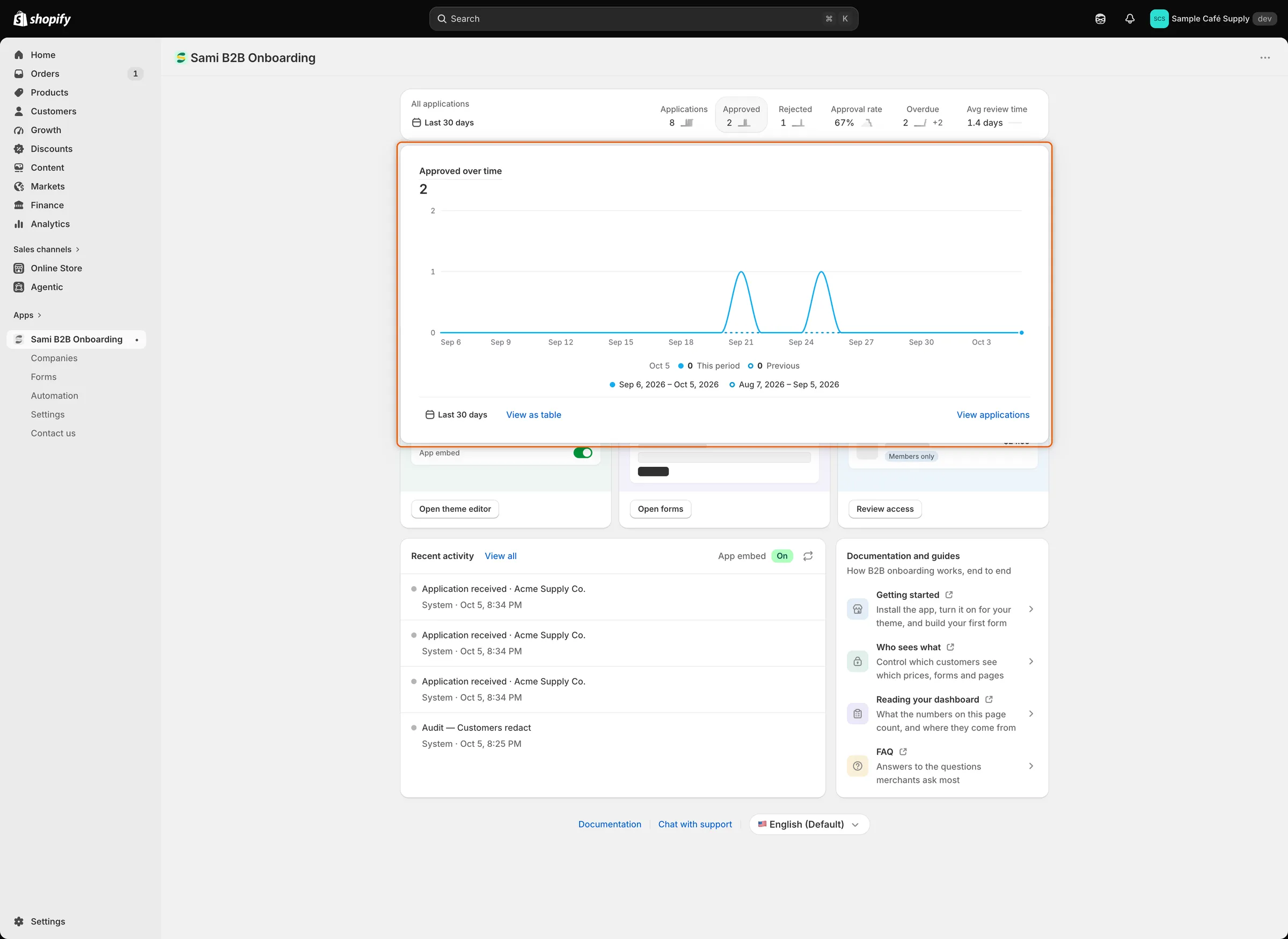
Click a number to compare this period with the previous one, day by day.
Change the period
Section titled “Change the period”-
Open the period picker
Click the period button, which shows a calendar icon and the current period.
-
Pick a period
Pick Today, Yesterday, Last 7 days, Last 30 days, Last 90 days or Last 12 months. You can also pick a start and an end date on the calendar.
-
Apply it
Click Apply. The numbers and charts update.
Home doesn’t keep the period you picked. It starts at Last 30 days each time you open it.
Search
Section titled “Search”The search box reads Ask about an application, company, or setting. Type at least two letters to find applications and companies. It also lists the app’s pages and, for admins, actions such as Create a registration form. Press Enter to open the first result.
To search from most other pages in the app, press ⌘ K on a Mac or Ctrl K on Windows.
Work waiting for you
Section titled “Work waiting for you”Under the search box, buttons show the work waiting, each with a count. A button only appears when its count is above zero. Click a button to open the list behind it.
| Button | What it counts | Where it goes |
|---|---|---|
| Review applications | New and resubmitted applications. | Companies › Applications, Needs your action view |
| Waiting on buyer | Applications in Needs info, waiting for the buyer to send what was asked for. | Companies › Applications, Waiting on buyer view |
| Overdue | Applications still undecided more than 3 days after they were submitted. | Companies › Applications, Overdue view |
| Documents expiring | Documents that have expired or expire within 30 days. | Companies › Documents |
Admins also see Import companies, which opens the page for importing companies from a CSV file.
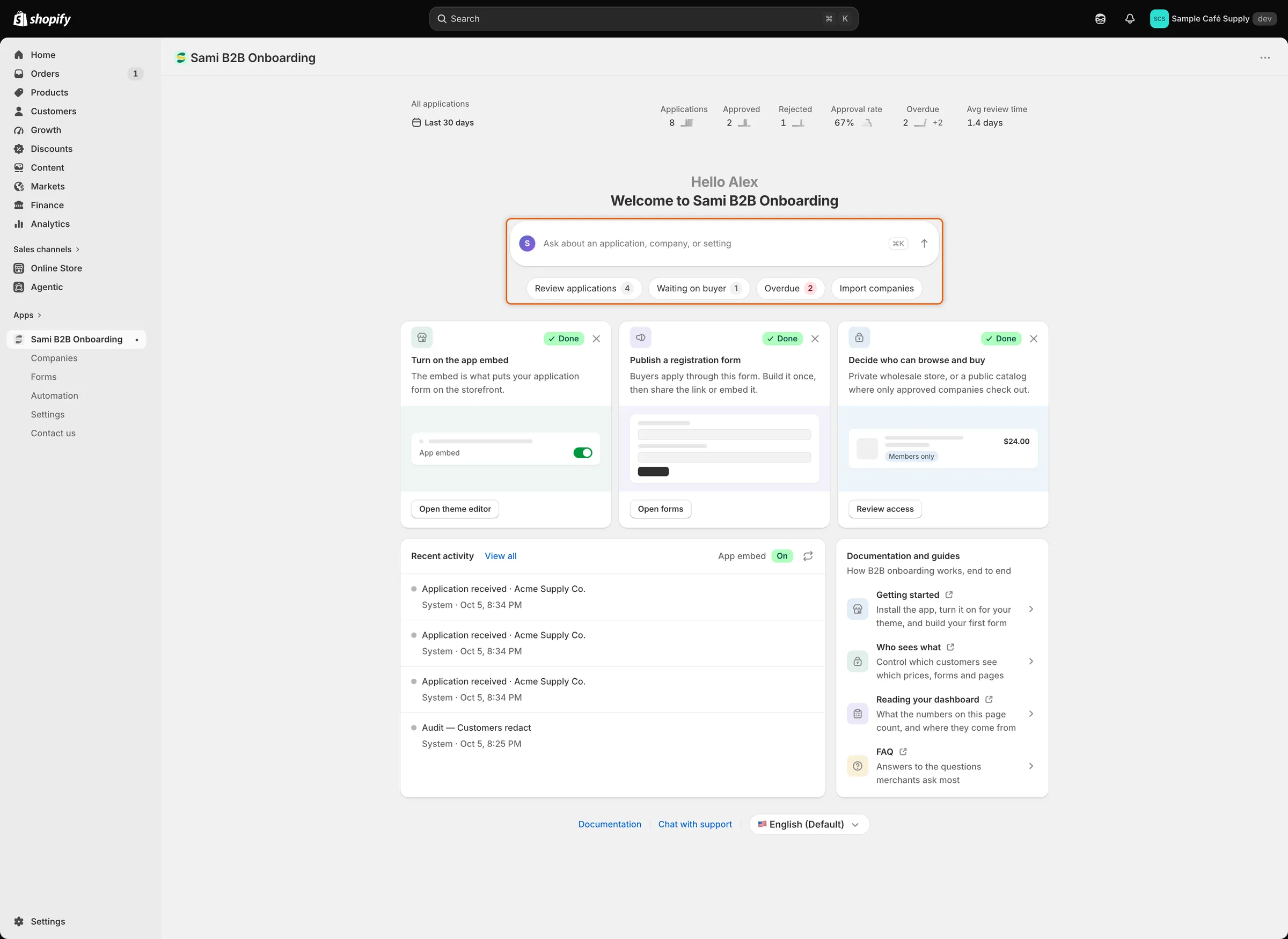
Each button opens the list behind its count.
Setup cards
Section titled “Setup cards”Admins see up to three setup cards. Each card shows Done once its step is finished.
| Card | Button | Done when |
|---|---|---|
| Turn on the app embed | Activate embed opens the theme editor with the embed switched on. | The embed is on in your published theme. The button then reads Open theme editor. |
| Publish a registration form | Open forms opens Forms. | At least one application form is published. The default form is, so this card starts as Done. |
| Decide who can browse and buy | Choose access opens Settings › Access. | You’ve saved your access settings. The button then reads Review access. |
To hide a card, click its ✕. It shows on cards marked Done, and on the others when you point at the card. A hidden card is hidden for your whole team. The cards still showing widen to fill the row. Once all three are hidden, click Show the setup steps again to bring them back.
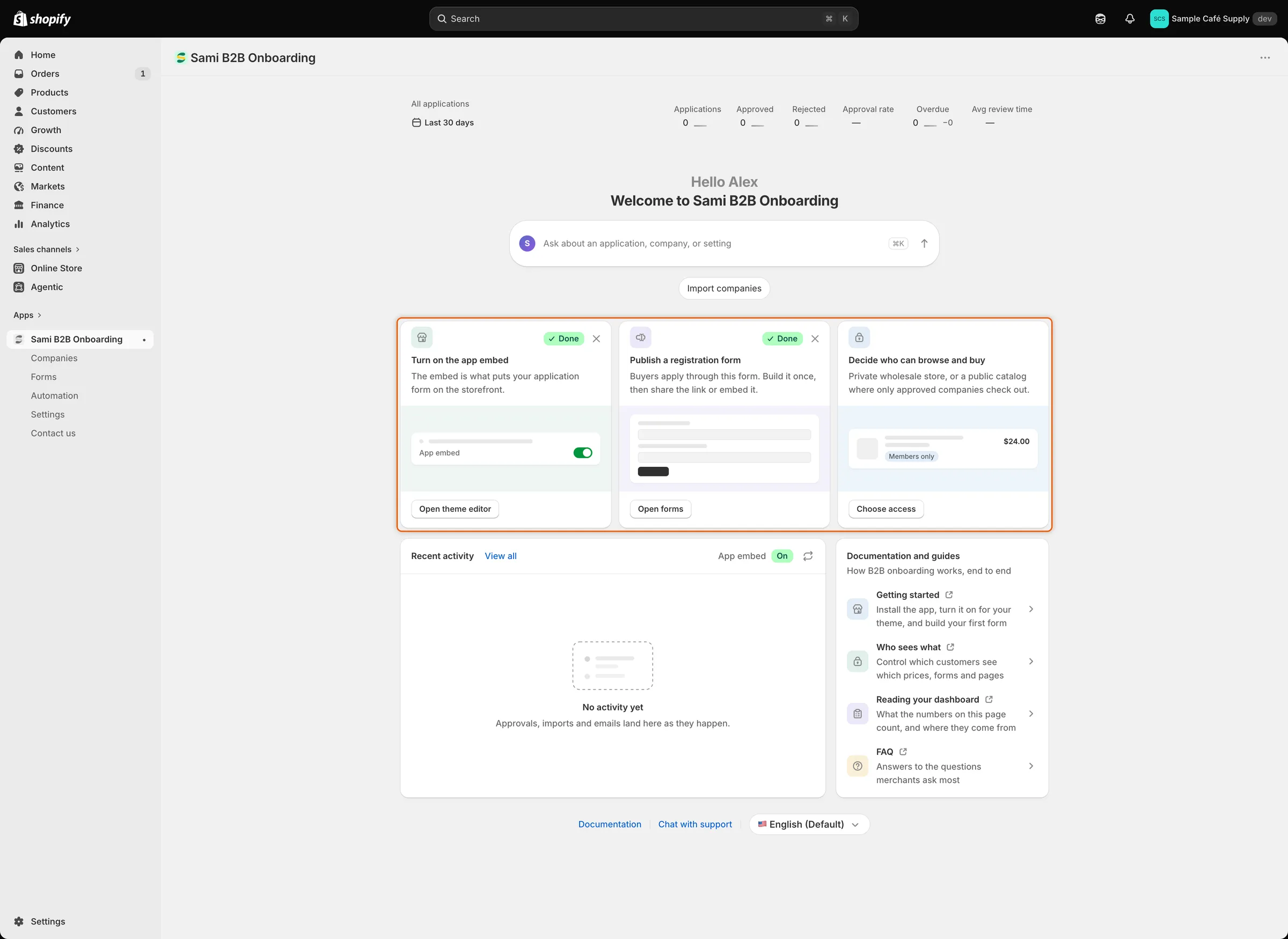
Finished steps show Done; click ✕ to hide a card you no longer need.
Recent activity
Section titled “Recent activity”The Recent activity card lists the latest four things that happened. Examples are a new application, an approval, an import or an email. Each line says who did it and when. View all opens Companies. For the full history, go to Activity log.
The card’s header shows the App embed status: On, Off or Checking…. When the embed is on, the refresh button checks again. When it’s off, admins see Open theme editor instead.
Documentation and help
Section titled “Documentation and help”- The Documentation and guides card links to four topics: Getting started, Who sees what, Reading your dashboard and FAQ. Each opens in a new tab.
- At the bottom of the page are a Documentation link and Chat with support, which opens the support chat.
- From time to time, Home asks admins to rate the app from one to five stars. To answer later, open the menu beside the stars and click Remind me later.
If Home can’t load its numbers, a Couldn’t load your latest numbers banner appears. Click Retry.
Change the app’s language
Section titled “Change the app’s language”The language picker sits at the bottom of Home, beside Chat with support. It shows your current language. Click it and pick another.
The app is available in English, Chinese (Simplified), Chinese (Traditional), Czech, Danish, Dutch, Finnish, French, German, Italian, Japanese, Korean, Norwegian (Bokmål), Polish, Portuguese, Spanish, Swedish, Turkish and Vietnamese.
Your choice applies only to you. Your teammates keep their own. Until you pick one, the app uses your Shopify admin language if it’s on that list, then your store’s language, then English. The picker changes the app’s screens only. To translate what buyers see, use Translate.
Next steps
Section titled “Next steps”- Quickstart — finish the setup steps and approve a test application.
- Review an application — work through the applications Home points you to.
- Turn on the app embed — get the first setup card to Done.
- Team and roles — choose who is an admin and who is a reviewer.