
Translate countdown text
Show different wording per storefront language, so each shopper reads the countdown in their own.
If your store sells in more than one language, a countdown can carry a different version of its text for each one. A shopper browsing in French sees the French wording; a shopper browsing in English sees the English. Same countdown, same timing, same design.
The app puts it plainly: you can translate the countdown’s content based on the online store’s locale. Customers with the en locale see the countdown in English; customers with the fr locale see it in French.
What you can translate
Section titled “What you can translate”Everything the shopper reads, per countdown type:
| Type | Translatable |
|---|---|
| Countdown timer | Title, Subtitle, the four timer labels (Days, Hours, Min, Sec), and the button’s text |
| Estimated delivery date | The delivery message, and the progress bar’s titles, descriptions, and tooltips |
| Stock countdown | The stock message |
| Cart countdown | The cart message |
Timing, conditions, and design are shared across every language — you’re translating the words, not building a separate countdown.
Which languages are offered
Section titled “Which languages are offered”The list comes from your store’s own published languages in Shopify, under Settings → Languages. Your primary language is the default.
Publish a new language in Shopify and it appears in the countdown’s language list the next time you open the builder. There’s no separate language list in the app to maintain.
Steps to translate a countdown
Section titled “Steps to translate a countdown”-
Open the countdown
Section titled “Open the countdown”Open the countdown you want to translate from the Countdowns list.
-
Write the default language version first
Section titled “Write the default language version first”Make sure the text is finished in your primary language before you translate it. Anything you change later has to be changed in every language separately.
-
Switch language in the top bar
Section titled “Switch language in the top bar”Find the language button in the builder’s top bar — it shows the current language’s name next to a translate icon. Click it and pick the language you want to write.
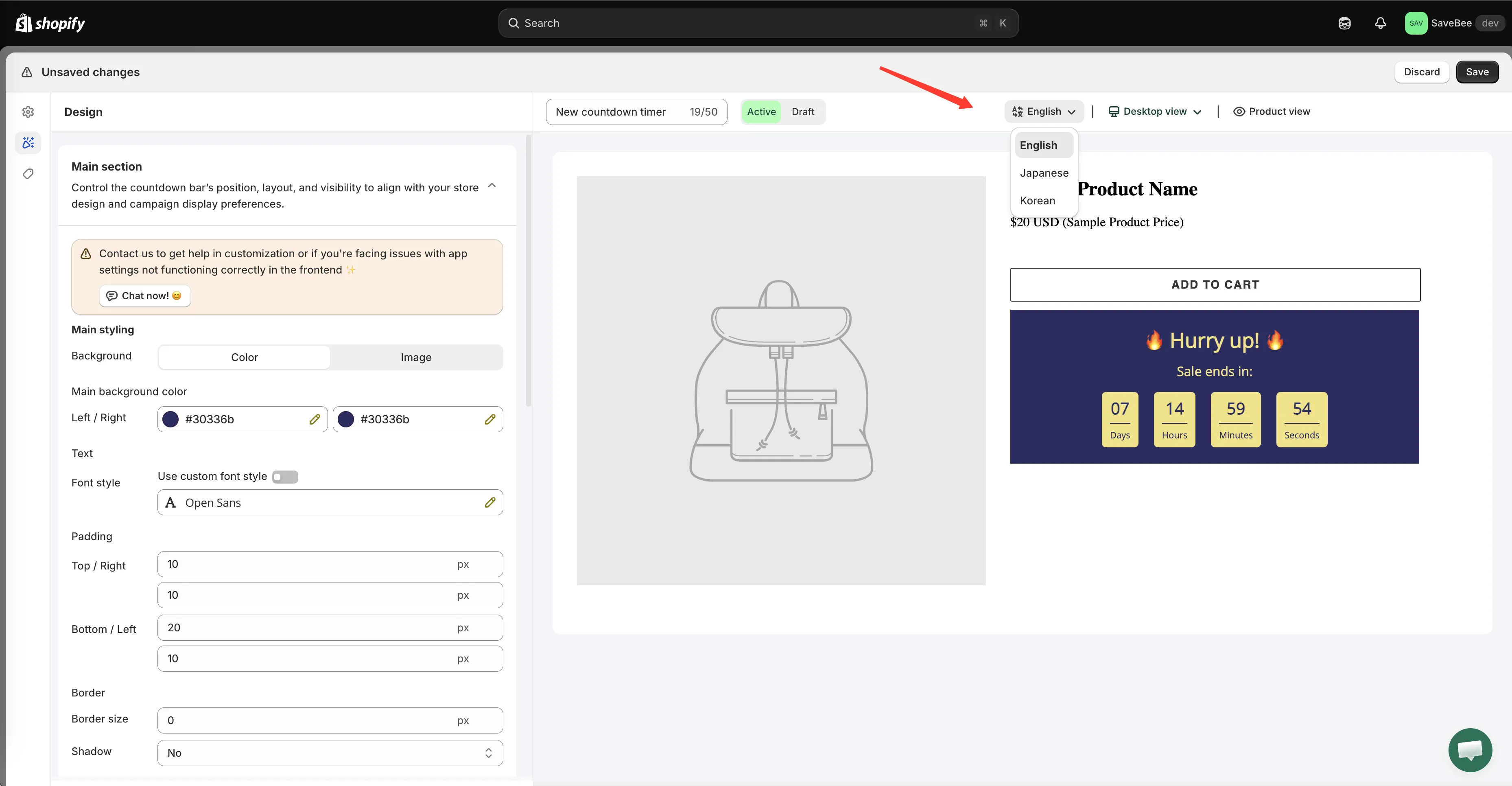
The language switcher in the builder’s top bar lists your store’s published languages.
-
Rewrite the text fields
Section titled “Rewrite the text fields”With that language selected, go through the Content section and write the text in that language. The fields now hold that language’s version — editing them doesn’t touch your default wording.
Translate the timer labels too, not just the headline.
Days/Hours/Min/Secleft in English inside otherwise-translated copy is the detail shoppers notice. -
Repeat for each language
Section titled “Repeat for each language”Switch again and repeat for every published language you want covered.
-
Click Save. All the language versions are saved together, as one countdown.
-
Check each language on your storefront
Section titled “Check each language on your storefront”Open your storefront and switch language using your theme’s own language selector — or add the locale to the URL, for example
your-store.com/fr/products/.... The countdown should show that language’s wording.Check the layout as well as the words: translations are often longer than the original, and a title that fits in English can wrap awkwardly in German.
Languages you haven’t translated
Section titled “Languages you haven’t translated”A language you don’t write a version for falls back to the default text. Shoppers in that language see the countdown with your primary wording rather than nothing at all — worth knowing when you publish a new storefront language and forget to come back here.
Translating versus targeting
Section titled “Translating versus targeting”Translation and conditions solve different problems:
- Translate when the offer is the same everywhere and only the wording changes. One countdown, several languages.
- Use a Language condition when the offer itself differs by market — different end dates, different delivery promises, different design. Separate countdowns, each with its own Language condition.
This is not the app’s own language
Section titled “This is not the app’s own language”Translating a countdown changes what shoppers read on your storefront. The language of the app’s admin interface is a separate setting in the dashboard footer — see App language.